
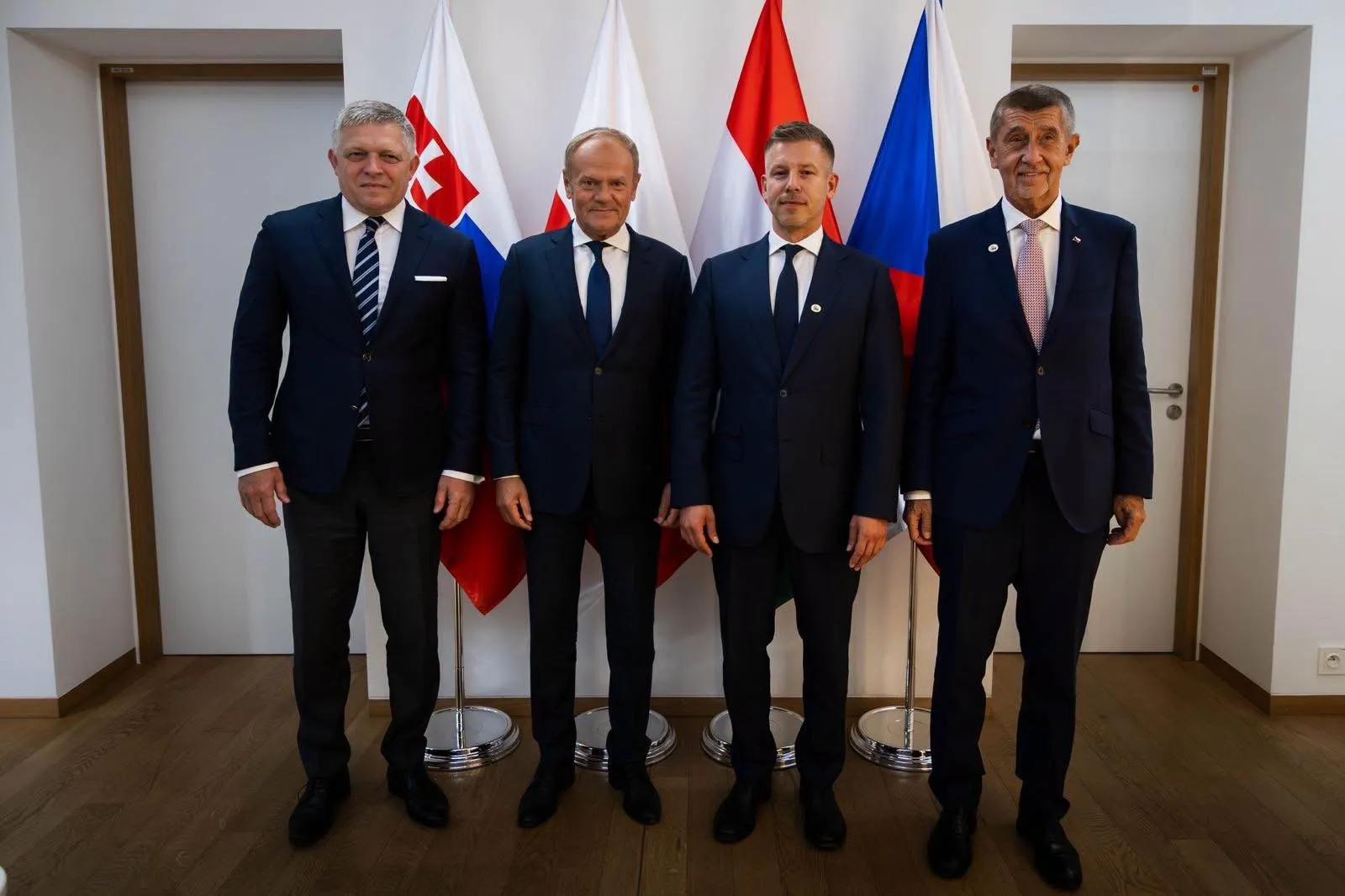
The politically successful V4 summit in Gödöllő (Hungary) did not bring about full political reunification, but a pragmatic relaunch. The V4 can be further revitalized if it operates as a ‘coalition of interests’, rather than as a ‘community of values’, for example, on issues such as the EU budget, cohesion funds, agricultural policy, energy prices, the Emissions Trading System (ETS), migration, transportation infrastructure, and competitiveness. The significance of the meeting lies in the fact that, after more than a two-year hiatus, the V4 met at the level of heads of government again — this time without Viktor Orbán, but hosted by the recently elected new Hungarian Prime Minister, Péter Magyar.
What Did the Summit Achieve? The most important outcome was the partial restoration of political trust. Péter Magyar wanted to demonstrate that Hungary is returning to regional and EU cooperation; Donald Tusk was testing whether the V4 could once again be an acceptable format from Poland’s perspective; Andrej Babiš was primarily seeking allies on the issues of energy prices, the ETS, and the EU budget; while Robert Fico outlined the agenda for the Slovak V4 presidency, which begins on July 1.
Consensus was evident in four specific areas: the EU’s multiannual budget for the period after 2028 (cohesion policy and the protection of agricultural subsidies); energy prices and industrial competitiveness; migration and the protection of external EU borders; and regional connectivity – including Péter Magyar’s proposal to build the Warsaw–Prague–Bratislava–Budapest high-speed rail link.
Can the V4 be revitalized? Yes, but only to a limited extent. The incentives for renewal are strong: the four countries share common interests in protecting cohesion funds, maintaining the importance of agricultural policy, protecting energy-intensive industries, adjusting the ETS system, tightening migration rules, and supporting EU enlargement in the Western Balkans. Donald Tusk remarked that the V4 could be ‘one of Europe’s greatest strengths’ if it returns to a modus operandi based on trust and loyalty.
However, the main obstacle to renewal remains mistrust regarding foreign policy, particularly with respect to Ukraine. The V4’s previous paralysis was mainly caused by Viktor Orbán’s pro-Russian policies and his role as a tackler on any issues related to Ukraine. However, Péter Magyar’s rise to power has partially resolved this obstacle, but full strategic unity remains unlikely due to Robert Fico’s policy toward Russia and Andrej Babiš’s pragmatic-populist EU policy.
Can the V4’s influence in the EU be increased? Yes, but only as a sectoral coalition. The V4 could strengthen its influence if it coordinated ahead of every European Council meeting and presented joint packages to EU institutions on the EU budget, cohesion funds, agricultural policy; energy prices, the ETS and industrial competitiveness; migration and border protection; or enlargement in the Western Balkans.
However, it is unlikely to emerge as a major political force within the EU if it lacks a common position and coordinated action on security policy issues, such as Russia, Ukraine, sanctions, military aid, and European defence. The V4 do not need to appear as a unified political bloc; it is still useful if it translates overlapping interests into a common position on specific EU policies.
Can the V4 be expanded? Formally, it would be hard; but in a V4+ format, yes. Apparent partners would be Austria on migration and energy; Germany on industrial policy, the automotive industry, and energy; Romania and Bulgaria on infrastructure, energy, and Schengen/border security; as well as Croatia and Slovenia on north–south transportation and energy corridors. Instead of a formal expansion, therefore, flexible V4+ coalitions should be expected.
Summary. The main outcome of the V4 summit in Gödöllő is that the Visegrad countries have returned to the negotiating table. They have not resolved their strategic differences, but they have reidentified some common, pragmatic interests. The renewal of the V4 can only be sustainable if it does not attempt to build an ideological bloc, but rather establishes a Central European negotiating position in areas such as the EU budget, energy and industrial policy, migration, and infrastructure development. The credibility of this renewed commitment to cooperation will ultimately depend on whether these ideas would be transformed into concrete joint projects and the necessary resources would be allocated to them.
June 24, 2026