
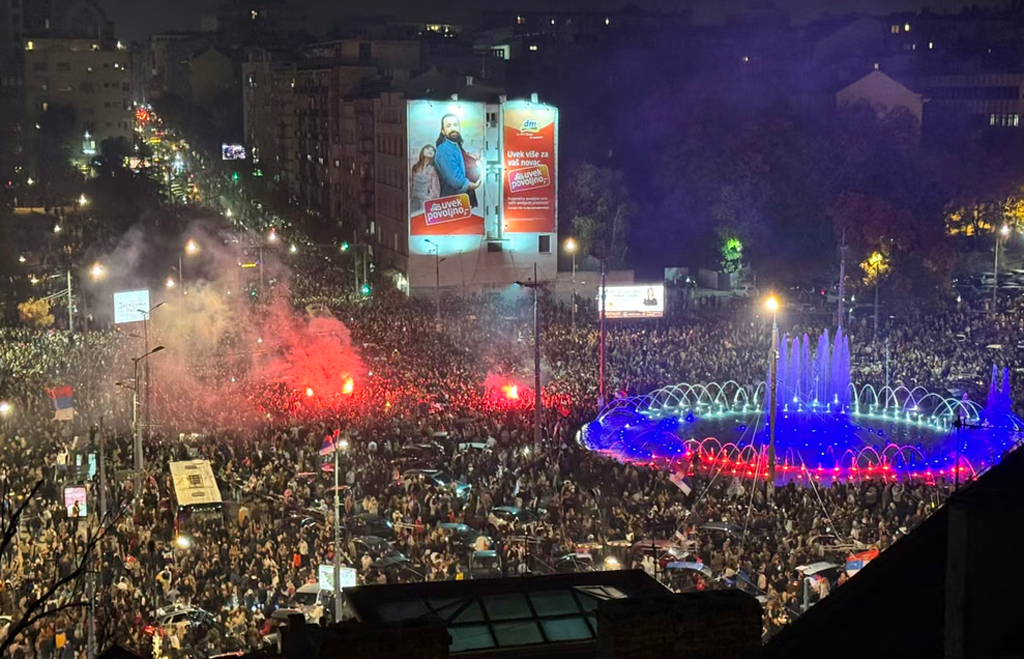
The parliamentary snap election of October 25, 2026 brought the 14-year rule of Aleksandar Vučić and the Serbian Progressive Party (SNS) to an end. According to preliminary results, the Student List won 52.71% of the vote and 140 seats in the 250-member parliament, while the alliance led by Vučić secured 39.17% and 104 seats. Turnout was record-high, approaching 69%. Aleksandar Vučić conceded defeat. The winning coalition can form a government on their own, but they do not have constitutional majority.
This election represents more than a simple change of government; it serves as an example of how social discontent can find political representation. The protests that followed the Novi Sad railway station tragedy in November 2024 grew from demands for accountability and action against corruption into a nationwide movement. The students’ decentralized organization, outreach beyond major cities, and distance from the established, traditional opposition parties enabled them to reach new voters. Corruption, the political dependence of public institutions, and methods of exercising power became the central themes of the campaign — not the divisive issues of identity and foreign policy.
Securing an electoral majority and transforming state power are two distinct tasks. The campaign was marred by the ruling party’s advantages in media access and financial resources available, while also reports of pressuring voters in several incidents emerged. Nevertheless, the conduct of voting on election day was assessed as satisfactory at most observed locations. Despite its defeat, SNS retains 104 MPs, a substantial social base, and links within local government and state institutions. A change of government therefore does not in itself dismantle the personal and economic dependencies established over the past decade and a half. The success of rule-of-law reforms will also depend on whether the new government can change the functioning of the police, security services, judiciary, public media, and state-owned enterprises lawfully and transparently, without political reprisals.
Student List’s greatest political strength is also a risk to its ability to govern. Student Lists’ members, who hold differing views, were united by opposition to the previous government and the goal of institutional renewal, rather than by a detailed political program. The movement’s collective decision-making must therefore be reconciled with executive tasks, budgetary decisions, and the day-to-day functioning of public administration. The outcome of the upcoming presidential election and the newly inaugurated government’s relation will pose further questions. With the traditional opposition parties weakened, disputes within the parliamentary majority may also acquire greater political significance.
Domestic political shift does not automatically imply a geopolitical realignment. The new political bloc includes both strong supporters of European integration and groups that place greater emphasis on national sovereignty. Democratic reforms could improve the conditions for cooperation with the EU, but the movement has so far made no commitment to adopting sanctions against Russia or announced a fundamental change in its position on Kosovo’s status. Dependence on Russian energy supplies, Chinese investment, and ties with Serb communities across the region continue to constrain foreign-policy choices. The new government’s foreign policy should therefore be judged by changes in individual areas rather than by an assumed turn towards the West.
For Hungary, the central question is the growing importance of institutional cooperation, replacing personal political ties. Energy and infrastructure projects, cross-border relations, and the protection of the rights of the Hungarian community in Vojvodina are enduring shared interests. According to the preliminary results, the Vajdasági Magyarok Szövetsége (VMSZ) won two parliamentary seats, placing its previous ties to the government in a new political context as a new majority takes shape. Hungary’s diplomatic room for maneuver will depend on the extent to which bilateral cooperation can evolve independent of personal ties, replacing the Orbán – Vučić alliance.
In the coming months, the sequencing of reforms, the capacity to govern, the terms of coexistence with established power networks, and the internal cohesion of the new majority will show whether social mobilization can be turned into lasting institutional change. The election has opened a new political opportunity, but its substance will be determined not by the result itself, but by the next phase of exercising power.
28 October 2026
Photo: nova.rs